
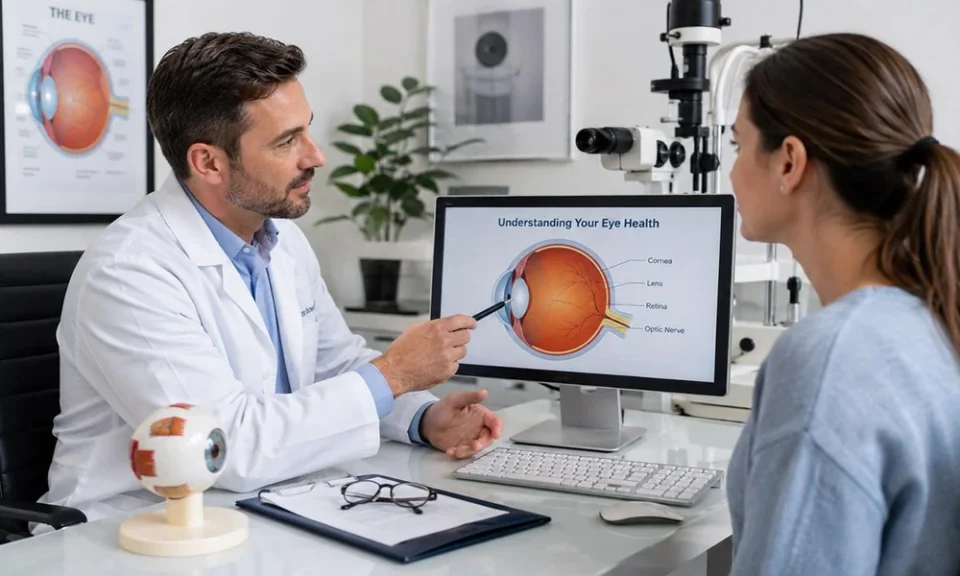
Not every “eye doctor near me” search leads to the same level of care. Anaheim has plenty of optometry storefronts for glasses and contacts, but anything involving disease, surgery, or a subspecialty condition calls for a full-service ophthalmology practice. Look for fellowship-trained specialists in cornea, retina, and oculoplastics, modern diagnostic technology, and a team that can manage your care long-term, not just for one visit.
Not all eye care practices are built the same, and the difference matters more than most people realize until they actually need it. A quick “eye doctor near me Anaheim” search will turn up dozens of results, but a shop that fits you for glasses in twenty minutes is a very different resource than a practice equipped to diagnose a retinal problem, manage glaucoma over decades, or perform reconstructive eyelid surgery. Anaheim Eye Institute has served Orange County since 1958, when it opened as the county’s first multi-specialty ophthalmology practice, and that history exists precisely because routine vision care and complex eye disease require different levels of training. Knowing which one you need, and finding a practice that offers both, is the real goal behind that search.
Optometrist, Ophthalmologist, or Subspecialist: What’s the Real Difference?
The key difference is training and scope. An optometrist completes a doctor of optometry degree and is well suited for routine eye exams, vision correction, and contact lens fittings but is not a medical doctor and is not trained to perform eye surgery. An ophthalmologist, by contrast, completes medical school followed by a residency in eye surgery and medicine, which qualifies them to diagnose and surgically treat eye disease, according to the American Academy of Ophthalmology.
This isn’t a hierarchy so much as a division of labor. The AAO explains that optometry training focuses heavily on refraction, prescribing lenses, and screening, while ophthalmology training is built around surgery, complication management, and ongoing medical care of the eye. Many people see an optometrist for years without ever needing anything more, and that’s exactly how the system is supposed to work. The distinction only starts to matter once a routine visit uncovers something a general exam wasn’t designed to handle.
When a Routine Visit Turns Into Something More
A self-contained answer here: if an exam reveals a disease process rather than a simple prescription change, that’s the point at which ophthalmology becomes necessary. Conditions like glaucoma, diabetic retinopathy, macular degeneration, cataracts, and corneal disease all require a medical doctor who can diagnose, monitor, and, if needed, operate.
Several health resources describe this process as a natural handoff rather than a failure of the first visit. Cleveland Clinic notes that when a serious condition such as glaucoma or diabetic retinopathy is suspected, moving to an ophthalmologist for treatment is the appropriate next step, and many patients continue seeing both providers in a coordinated way, with the optometrist handling routine monitoring and the ophthalmologist managing disease progression or surgery. That kind of collaborative model works well when both providers are easy to reach, but it works even better when the more advanced care is available locally and the transition doesn’t mean starting over with an unfamiliar office across town.
Why Fellowship Training Changes What a Practice Can Actually Treat
Ophthalmology itself has subspecialties, and “fellowship-trained” is the term that signals a doctor has gone beyond general ophthalmology residency to focus intensively on one part of the eye. After four years of medical school and a three-year residency, a fellowship adds one to two more years of focused training in a specific area, giving that physician deeper command of the most advanced treatments available in that field, as described by ophthalmology training programs.
This matters because eye conditions are not interchangeable. A cornea subspecialist manages conditions like keratoconus and Fuchs’ dystrophy and often performs corneal transplants and refractive surgery. A retina specialist focuses on conditions like macular degeneration and diabetic eye disease, frequently the most competitive and heavily subscribed of the ophthalmology fellowships. An oculoplastic surgeon, a term that simply means a specialist trained in the eyelids, tear ducts, and the orbit (the bony socket surrounding the eye), completes one to two additional years of fellowship after residency and is recognized by the AAO as an expert in eyelid, orbit, and lacrimal surgery, useful for anything from drooping eyelids to reconstructive work around the eye. A practice that covers all three of those areas, along with general ophthalmology for cataracts and glaucoma, can usually keep a patient’s care in one place rather than sending them out for multiple referrals.
What to Actually Look for in a Local Practice
Fellowship training is the foundation, but it’s not the only thing worth checking before choosing where to go. Board certification is verifiable for free, and the AAO maintains a physician finder that confirms active membership and area of practice, a step worth taking before committing to ongoing care.
Technology is the next piece, though it’s easy to overweight on its own. Modern diagnostic equipment, from retinal imaging to corneal topography, genuinely improves the speed and accuracy of a diagnosis, but it’s most valuable in the hands of a specialist who knows what the images mean for a particular patient. A practice that treats a wide range of conditions, from cataract surgery to glaucoma management to eyelid and orbital concerns, tends to invest in equipment across all of those areas rather than just one.
The last factor is continuity, and it’s the one people underestimate until they’re mid-treatment. Chronic conditions like glaucoma are managed over years, sometimes decades, and switching providers partway through means re-explaining history and repeating tests that a continuous record would have avoided. A practice built for the long haul, with subspecialists on staff rather than a rotating referral list, tends to make that long-term relationship simpler for the patient.
A practice that can diagnose, treat, and follow a condition for years spares patients the friction of starting over elsewhere.
What a First Visit at a Full-Service Practice Looks Like
A first visit at a practice like this usually starts the same way a routine eye exam would: vision testing, a look at eye health, and a conversation about history and any symptoms. What’s different is what happens if something beyond a prescription turns up. Instead of a referral to a separate office, the conversation can move directly into next steps with a specialist who already has access to the exam findings, whether that means monitoring a cataract’s progression, starting glaucoma treatment, or evaluating a retinal or eyelid concern.
That continuity is really the point of choosing a full-service ophthalmology practice from the start, rather than switching only after a problem is already identified. It doesn’t mean routine visits become more complicated. It means that if something does come up, you already have a plan for what to do next.
When It Makes Sense to Switch
There’s no single sign that it’s time to change practices, but a few situations tend to prompt it. Being referred out repeatedly for anything beyond a basic exam is one. A chronic condition that would benefit from specialist continuity rather than periodic outside referrals is another. And simply wanting a local, established practice that a patient won’t outgrow as their eye care needs change over time is a reasonable enough reason on its own.
For many Orange County residents, that search for “eye doctor near me Anaheim” isn’t really about finding the closest office. It’s about finding one that can grow with them, from a first pair of glasses in their twenties to cataract surgery decades later, without ever needing to start the search over.
The Bottom Line
Choosing an eye doctor near Anaheim means matching the level of care to what a patient might eventually need, not just what they need today. A general optometry visit covers most routine needs well, but anything involving disease, surgery, or a subspecialty condition benefits from a practice built around fellowship-trained ophthalmologists who can manage it from diagnosis through treatment.
Anaheim Eye Institute has been part of that decision for Orange County families since 1958, built from the start as a multi-specialty practice rather than a single-doctor office. Have questions about your vision or ready to explore your options? The team at Anaheim Eye Institute has been helping Orange County patients see clearly since 1958.
Book an Appointment or call 714.533.2020.
This article is for general educational purposes and is not a substitute for a personalized medical evaluation. Please consult an eye care professional regarding any specific symptoms or concerns.
FAQ
Is an ophthalmologist better than an optometrist? Neither is inherently “better”; they simply serve different purposes. Optometrists are well suited for routine eye exams and vision correction, while ophthalmologists are medical doctors trained to diagnose and surgically treat eye disease. Many patients use both, with an optometrist handling routine care and an ophthalmologist managing anything more complex.
What does “fellowship-trained” mean for an eye doctor? It means the ophthalmologist completed one to two years of additional focused training beyond general residency in a specific area like cornea, retina, or oculoplastics. This extra training allows them to manage more advanced and specialized conditions within that subspecialty.
When should I see an ophthalmologist instead of an optometrist? If an exam reveals a disease process, such as glaucoma, diabetic retinopathy, macular degeneration, or cataracts, or if surgery is being considered, an ophthalmologist is the appropriate provider. An optometrist usually handles a routine prescription check or contact lens fitting well.
What is oculoplastics, and why would I need it? “Oculoplastics” refers to surgical care of the eyelids, tear ducts, and the orbit, the bony socket around the eye. Patients see an oculoplastic surgeon for concerns like drooping eyelids, eyelid growths, tear duct blockages, or reconstruction after injury.
How do I know if a local eye practice is a good fit long-term? Look for verifiable board certification, a range of subspecialties, modern diagnostic technology, and a history of managing patients over time rather than just single visits. A practice that can treat a condition from diagnosis through ongoing management saves patients from repeated referrals elsewhere.
